
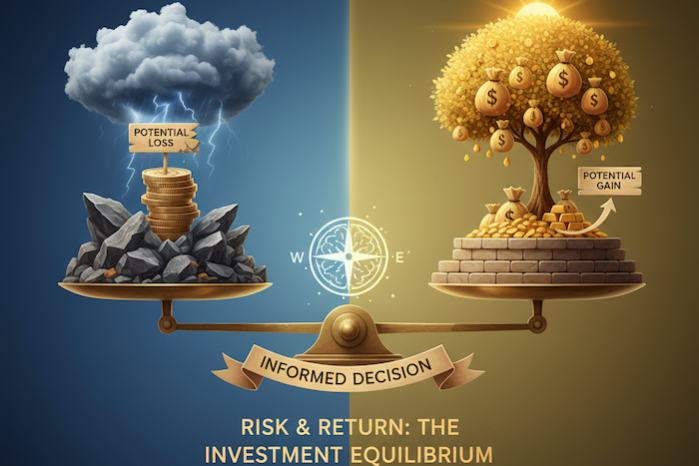
Investing always involves a trade-off between risk vs return. Higher potential returns usually come with greater risk—or more precisely, greater uncertainty of outcomes. For investors in Australia, managing this trade-off effectively means employing strategies that pursue growth while minimising the risk of extreme losses. Below, I explain why balancing risk vs return is crucial, describe common strategies (diversification, hedging, asset allocation), how they work together, provide practical examples, and outline pitfalls to avoid. I also emphasise that individual circumstances matter, and it's wise to consult a financial professional to build a plan suited to your goals and risk appetite.
Why Balancing Risk Vs Return Matters
- Uncertainty and Loss Can Compound Poorly
Markets are volatile. Investment values fluctuate. If one takes overly risky positions and the timing is poor (e.g. large losses just before needing the money), the results can be very damaging. For example, retirees face “sequencing risk” ‒ that is, experiencing poor returns at the wrong time. Research by the Actuaries Institute in Australia shows that those just before or after retirement are particularly vulnerable. (Actuaries Australia) - Return Consistency vs Peak Returns
While chasing high returns (say, high growth equity, small-cap, emerging markets) may lead to big wins, the path is often jagged: sharp drops, long recoveries, sometimes extended periods of underperformance. Many investors prefer smoother returns over time, especially if they have nearer objectives (buying a house, funding education, or entering retirement). - Risk Preferences Differ
Not all investors are alike. Some can tolerate high volatility, others cannot. And many Australians have liabilities (e.g. mortgages, living costs), or “super” savings that will need to be drawn down. Risk that seems abstract may have concrete consequences for lifestyle. - Opportunity Cost of Too Much Safety
Conversely, being overly conservative (too much cash, low risk bonds) can mean missing out on growth, especially over long horizons (decades). Inflation erodes real value of money if returns are too low. So there is a balance needed.
Common Risk Mitigation & Return Strategies
Below are three key strategies, their benefits, and limitations.
| Strategy | What It Is / How It Works | Benefits | Limitations / Costs |
| Diversification | Spreading investments across multiple asset classes (e.g. equities, bonds, property), sectors, geographies, and—within those—across different managers/products. Idea: not all assets move together. (Moneysmart) | − Reduces idiosyncratic risk (i.e. risk tied to one company or sector). − Helps smooth out returns: when some assets underperform others may outperform.− In Australia, adding foreign (global) equity, property & alternative assets tends to improve risk-adjusted returns (Sharpe ratios) in many models. E.g. property + infrastructure allocations from studies show risk-adjusted improvement. (PRRES) | − Diversification doesn’t eliminate market risk (systematic risk, macro risk). In severe downturns many asset classes drop together. − Costs: more fees, complexity, possibly lower short-term returns if top performing assets dominate. − Over-diversification can dilute return gains. − Some asset classes are illiquid (property, alternatives), have high entry costs or valuation difficulties. |
| Hedging | Using financial instruments (derivatives) or structural strategies to reduce exposure to certain risks (currency, interest rate, commodity price, etc.). Also includes “natural hedges” (matching asset/liability, matching revenues & costs). (HUDSON Financial Partners) | − Reduces volatility from non-investment risks (e.g. currency swings for international investments). − Can protect portfolios in adverse conditions (e.g. when AUD strengthens, hurting overseas equity returns). − Allows some exposure to high return assets with mitigated risk. − Particularly useful for those close to needing funds or with less time to recover losses. | − Hedging costs money: derivative premiums, management fees. − Hedging may reduce upside (you pay for protection). If things go favourably, hedged positions lag unhedged. − Complexity: implementing hedges properly requires skill and monitoring. − Liquidity and counterparty risk possible when using derivatives. − In some cases, the cost/benefit balance is marginal. |
| Asset Allocation (Strategic & Tactical) | Deciding what proportion of the portfolio to put into different asset classes (equities, fixed income, property, cash, alternatives etc.), adjusting over time (age, market outlook, risk tolerance). Strategic allocation is the long-term mix; tactical is shorter-term tilts. | − Core tool: a well-chosen allocation is the primary driver of risk and return. − Can tailor exposure: more growth when young, more defensive as one nears goals. − When combined with rebalancing, it helps keep risk in check and enforces discipline. − Empirical studies show that adding fixed income and alternative assets to equity portfolios can improve risk-adjusted returns. For example, PIMCO Australia analyses show diversified fixed income has expected return nearly close to equities but with much less volatility. (PIMCO) | − If allocation is too aggressive, volatility and drawdowns may cause psychological or financial strain. − If too conservative, missed growth. − Tactical adjustments are tricky; market timing is hard. − Changing allocations repeatedly may incur taxes, transaction fees. − Risk that past correlation patterns change in future. E.g. equities and bonds have not always moved inversely; sometimes they move together in inflation or crisis periods. (Reserve Bank of Australia) |
How These Strategies Can Work Together
No single strategy is sufficient. Typically, combining them gives better protection while still allowing growth.
- Start with Asset Allocation
Determine a strategic mix tailored to your goals, timeframe, and risk tolerance. For example, a younger investor might accept e.g. 70-80% growth assets (equities, property, alternatives) and 20-30% defensive (bonds, cash), whereas someone approaching retirement might target perhaps 40-50% growth and more defensive components. - Diversify Within and Across Asset Classes
Once you know your broad allocation, diversify within each class: within the equity portion, include Australian and international equities; across industries, include small caps, large caps, and emerging markets. Within fixed income: government, corporate, maybe inflation-linked. Include other assets (property, infrastructure, gold etc.) where possible. Studies in Australia show that including “real assets” (property, infrastructure) or “alternatives” increases risk-adjusted return in many multi-asset portfolios. (PRRES) - Hedging Key Risks
Some portions of your portfolio may be exposed to risks that you especially want to limit, e.g. foreign currency risk for overseas assets, interest rate risk, and inflation risk. Use derivatives or hedged funds for these parts, or structurally position so that risks are naturally offset. For example, many Australian superannuation funds hedge a large share of their foreign debt/infrastructure exposure but less of their equity exposure. (Reserve Bank of Australia) - Rebalancing & Monitoring
Over time, some asset classes will outperform others, changing the proportions in your portfolio (e.g. equities run up, bonds lag). Rebalancing—selling portions of over-weighted assets, buying under-weighted ones—brings portfolio back to intended risk level. Also monitoring market / economic regime changes so that assumptions (e.g. correlation between equities and bonds) are still valid. For example, “alternative diversifiers” such as long-volatility strategies and cross-asset trends are being used more, since fixed income sometimes fails in its role as a buffer when correlations shift. (Russell Investments) - Adjusting for Life Stage, Goals, Liquidity Needs
As one approaches goals (e.g., retirement, major purchase), reducing exposure to risk or making portions of the portfolio more liquid becomes increasingly critical. Similarly, if you need funds in a shorter time horizon, you cannot afford large drawdowns.
Practical Examples
- Balanced Super Fund in Australia: Many balanced funds, often default or “growth” options in superannuation, mix growth assets (~60-70%) with defensive (~30-40%). In good years this gives outsized returns; in down years the defensive portion cushions the loss. E.g. in 2024 balanced options delivered about 11.5% return across many super funds. (The Australian)
- Fixed Income vs Equity in Risk-Adjusted Return: A PIMCO study showed a diversified fixed income portfolio in Australia with an expected return of ~5.27%, volatility ~4.29%, compared with equities at ~6.02% return but ~12.66% volatility. So equities give higher return but come with almost three times the volatility. The fixed income component helps smooth. (PIMCO)
- Currency Hedging: An investor holds offshore equities. Without hedging, the return in AUD depends on both the equity performance and the AUD exchange rate. If AUD strengthens, that can reduce AUD returns; if it weakens, increase them. Some funds offer hedged versions to reduce this volatility. For example, Perpetual Group offers a “hedged” version of a global share fund to manage this risk. (Perpetual)
- Adding Alternative Diversifiers: Research by Russell Investments shows that including small allocations (5-10%) of “alternative diversifiers” such as long-volatility strategies or cross-asset trend following helps reduce drawdowns and improve portfolio performance when traditional diversifiers (like bonds) are less effective. (Russell Investments)
Benefits vs Limitations: What to Watch Out For
Below are common upsides and downsides together with pitfalls to avoid.
| Benefit | Limitation / Risk | Common Pitfalls |
| Smoother returns over time; less stress during downturns | Reduced upside in strong bull markets, due to hedging, conservative allocations, fees | Overconfidence: assuming historical patterns (e.g. low equity-bond correlation) will always hold Under-estimating costs (transaction costs, management/hedging fees, taxes) Over-diversifying: too many small allocations so that monitoring, cost, complexity rise without proportionate benefit Poor timing / emotional investing: reacting to short-term volatility rather than sticking to plan Ignoring liquidity: parts of portfolio may be hard to sell when needed Not rebalancing: drift can lead to unintended risk exposure Not tailoring to individual goals or cash needs (e.g. needing funds in 5 years vs 30 years) |
How Risk & Return Strategies Can Be Combined in an Investor’s Portfolio
Putting the pieces together, here’s a sketch of how an investor might build a risk-mitigated yet growth-oriented portfolio.
- Step 1: Set Clear Goals & Time Horizon
E.g. “I want to grow my capital over 20 years for retirement, but I expect to draw some income in the last 5 years”. - Step 2: Determine Risk Tolerance
How much loss can you tolerate (both financially and emotionally)? What happens if your portfolio drops 30%? Can you wait it out? - Step 3: Choose Strategic Asset Mix
Suppose someone aged 40, aiming for retirement at 65, moderate risk tolerance: a mix like ~65% growth assets (split: Australia large-cap equities, international equities, property/infrastructure, alternatives), 25% fixed income, 10% cash/short-term defensive. - Step 4: Diversify Within Asset Classes
Within growth: include Australian vs international, large vs small cap, growth vs value. Include real assets. Fixed income: include government, corporate, inflation-linked; perhaps some foreign debt if comfortable, with/without hedging. - Step 5: Use Hedging Where It Makes Sense
• For overseas debt/infrastructure projects, consider currency hedging. • Inflation protection for fixed income or real assets. • Interest-rate risk (if bond durations are long) managed via laddering or shorter duration exposure. - Step 6: Rebalance Regularly
Perhaps annually or when allocations drift by a threshold (e.g. 5-10%). During strong equity rallies, that portion may grow much larger than intended; rebalancing ensures you take profits and reallocate to defensive assets. - Step 7: Monitor Regime Changes & Stress Test Assumptions
Keep an eye on inflation, interest rates, geopolitical risk, correlation shifts (e.g. bonds and equities moving together). Use scenario analysis or stress tests: “what if equities drop 40%?”, “what if inflation spikes?”, etc.
Data Insights: What the Australian Evidence Suggests
- Super funds’ balanced options returned ~11.5% in 2024. That’s an example of growth with some risk mitigation (defensive assets). (The Australian)
- In studies of Australian multi-asset portfolios that include property and alternatives, increasing allocation to property + alternatives from ~27% (current average in some super fund balanced portfolios) to ~33% improved risk-adjusted returns (Sharpe ratios) over long backtests. (PRRES)
- Periods when equities and bonds are highly correlated (e.g. inflationary regimes or rising interest rates) diminish the buffering effect of bonds, so relying solely on fixed income for defence can be risky. Scholars point out that the stock-bond correlation in Australia has been unstable historically. (Reserve Bank of Australia)
- Hedging foreign currency exposure is common: super funds hedge around 70% of their international debt and unlisted infrastructure exposures, but only ~25% of their international equity exposures. This reflects that equity returns both depend on underlying performance and currency moves, which can work for or against the investor. (Reserve Bank of Australia)
Common Pitfalls to Avoid
- Chasing Past Performance
Just because some assets did very well in recent years (e.g. tech stocks, or a strong dollar) doesn’t mean they will in future. - Over-confidence in Defensive Assets
Assuming bonds (or fixed income) will always cushion losses is dangerous. In inflationary environments or when interest rates rise rapidly, bond prices fall. If equities also fall, the loss on both can be worse. - Ignoring Costs
Fees, taxes, trading costs, costs of hedging—they all eat into returns. Sometimes what seems like a small drag in return becomes large over long periods. - Poor Liquidity
Investments that are hard to sell quickly (property, some alternatives, unlisted infrastructure) may be hard to convert when needed. - Emotional Reactivity
Selling when markets fall out of fear, or doubling down in bubbles, just because things are going well, often destroys more value than the cost of staying the course. - One-Size-Fits-All
Risk tolerance, income needs, tax situations, wealth, age, health, other liabilities—all make a big difference. A portfolio suited for someone with decades of income ahead is quite different from someone nearing retirement.
Summary & Takeaways
- You need growth to beat inflation, but you also need protection so that downturns don’t derail your life plans.
- Three core tools: diversification, hedging, and appropriate asset allocation + rebalancing.
- Combining them thoughtfully can reduce the risk of big losses, smooth out returns, and still allow you to participate in good growth opportunities.
- Stay aware of costs, changing market regimes, and your own needs (time horizon, liquidity, risk comfort).
- Evidence from Australia (super funds, academic studies) supports that balanced portfolios with a portion in defensive assets + alternatives + selected hedging outperform in risk-adjusted terms over long horizons.
Why It’s Important to Consult a Financial Professional
No matter how much you read or plan, a financial professional can help because:
- They can assess your personal risk tolerance, financial situation, tax status, liquidity needs.
- They can design a plan specific to your goals (e.g. target returns, income needs, retirement).
- They can help you avoid bad behaviour (over-trading, emotional decisions).
- They often have access to better tools, data, products (e.g. managed funds, hedged versions, alternative asset exposures) than retail investors do on their own.
- They can monitor and adjust your plan over time, especially as markets, laws, or your situation change.
If you like, I can prepare a sample portfolio mix for different kinds of Australian investors (young, mid-career, pre-retiree) showing how these strategies might be put into practice. Would you prefer that?
References
- Vanguard, Vanguard’s approach to constructing Australia’s Diversified Funds. (Vanguard Fund Docs)
- Australian Government’s MoneySmart, Diversification. (Moneysmart)
- State Street Global Advisors, Home Bias in Australian Equity Allocations Diminished Portfolio Outcomes (2024). (SSGA)
- Reddy, W. & Wejendra, Real asset allocation: Evaluating the diversification benefits of property and alternative asset classes in Australian superannuation portfolios. (PRRES)
- First Sentier Investors, Risky asset allocation: How alternatives might fit into a portfolio (Australia, May 2022). (First Sentier Investors)
- State Street Global Advisors, Gold for Australian Investors: A Portfolio Diversifier With Staying Power. (SSG=A)
- Russell Investments, Alternative diversifiers: Rethinking diversification in investment portfolios (Australia, 2025). (Russell Investments)
- Australian Actuaries Institute, Sequencing Risk and Asset Allocation (2025). (Actuaries Australia)
- Reserve Bank of Australia, A Century of Stock-Bond Correlations. (Reserve Bank of Australia)
- PIMCO Australia, Bonds Have an Important Role to Play in Australian Investment Portfolios. (PIMCO)
- Perpetual, Why it’s Time to Consider Currency Hedging Your Portfolio (Australia). (Perpetual)
- RBA, Foreign Currency Exposure and Hedging in Australia (2023). (Reserve Bank of Australia)
