
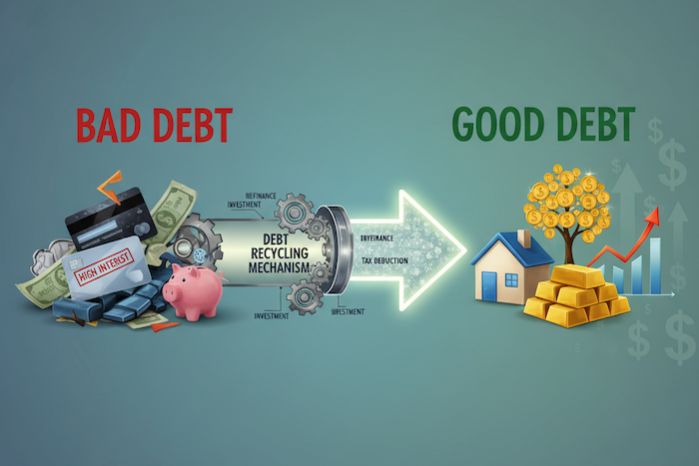
For many Australians, the home mortgage represents the single most significant financial commitment of their lives. It is often referred to as "bad debt" because the interest paid on it is generally not tax-deductible. It is a necessary expense for shelter, but it does not directly generate assessable income. However, what if you could strategically transform this financial burden into a powerful engine for wealth creation?
This is the core promise of debt recycling, a sophisticated financial strategy that involves converting non-deductible personal debt, such as a home loan, into tax-deductible investment debt (1). It is not a magic trick, but a disciplined, long-term approach that leverages the Australian Taxation Office’s (ATO) rules on interest deductibility to accelerate mortgage repayment and build an investment portfolio simultaneously.
As a financial advisor in Australia, I must emphasise this from the outset: debt recycling is a complex strategy. It is only suitable for certain individuals, and its successful implementation hinges on meticulous execution and an unwavering commitment to documentation. Before taking a single step, you must seek professional advice from a licensed financial planner, a mortgage broker, and a tax adviser. The information presented here is for educational purposes and is not a substitute for tailored personal advice.
II. Deconstructing the Strategy: How Debt Recycling Works
The mechanism of debt recycling is deceptively simple, yet its legal and structural requirements are stringent. The strategy capitalises on a fundamental principle of Australian tax law: the purpose of the borrowing determines the deductibility of the interest, not the asset used as security for the loan (2).
The Core Mechanism: A Step-by-Step Breakdown
The process typically begins once a homeowner has built up a significant amount of equity in their principal place of residence. This equity is the key resource that is "recycled."
1.Creating Equity: This is achieved through regular principal and interest repayments on the home loan, or by making lump-sum contributions, often held in an offset account.
2.Loan Restructuring: This is the most critical step. To maintain a clear audit trail for the ATO, the original home loan must be restructured. This usually involves establishing a split loan or a separate loan facility (such as a line of credit) that is distinct from the primary home loan (3). This new split loan is secured by the home equity but is legally a separate debt facility.
3.The Withdrawal: The principal that has been repaid on the non-deductible home loan is then re-borrowed from the new, separate loan split.
4.The Investment: The re-borrowed funds are immediately and exclusively applied to the purchase of an income-producing asset. This could be a diversified portfolio of shares, managed funds, or an investment property.
The Role of Investment Borrowing in Conversion
The conversion from non-deductible to deductible debt occurs at the point of investment. When you make a repayment on your home loan, you are paying down "bad debt." When you re-borrow that exact amount and use it solely to acquire an asset that is expected to generate assessable income, the interest on that re-borrowed amount becomes deductible.
The ATO’s position, as outlined in Taxation Ruling TR 95/25, is clear: if the borrowed money is used to produce assessable income, the interest on that loan is deductible (4). This ruling confirms that even if the money is drawn from a facility originally used for private purposes (like a home loan), the new use of the re-borrowed funds dictates the tax treatment. This is the legal foundation upon which the entire debt recycling strategy rests.
III. The Tax Advantage: Converting Non-Deductible to Deductible Debt
The primary benefit of debt recycling is the creation of a tax deduction where none existed before. To understand the magnitude of this advantage, we must look to the legislative basis.
The Legislative Basis: Section 8-1 of the ITAA 1997
The deductibility of interest is governed by Section 8-1 of the Income Tax Assessment Act 1997 (ITAA 1997), which permits a deduction for any loss or outgoing to the extent that it is incurred in gaining or producing assessable income (5).
In the context of debt recycling, the interest paid on the new, separate loan split is an outgoing incurred for the purpose of generating investment income (e.g., dividends, rent, or capital gains). Therefore, this interest expense is deductible against your assessable income.
The Financial Impact: A Dual-Benefit Strategy
The tax deduction provides a significant cash flow benefit, particularly for individuals on higher marginal tax rates.
| Marginal Tax Rate (2024-25) | Tax Saving per $1,000 of Deductible Interest | Effective Interest Rate (After Tax) |
| 19% (up to $45,000) | $190 | 81% of nominal rate |
| 32.5% ($45,001 to $135,000) | $325 | 67.5% of nominal rate |
| 37% ($135,001 to $190,000) | $370 | 63% of nominal rate |
| 45% (over $190,000) | $450 | 55% of nominal rate |
Note: Excludes Medicare Levy of 2% for simplicity.
Consider a high-income earner on the 45% marginal tax rate who successfully recycles $200,000 of their mortgage into investment debt at a 6.5% interest rate.
- Annual Interest Expense: $200,000 x 6.5% = $13,000
- Tax Deduction Value: $13,000 x 45% = $5,850
- Net Cost of Interest: $13,000 - $5,850 = $7,150 (or an effective rate of 3.575%)
This annual tax saving of $5,850 can be immediately directed back into the non-deductible portion of the home loan. This creates a powerful, self-funding cycle: the tax benefit accelerates the repayment of the non-deductible debt, freeing up more equity to be recycled, which in turn generates a larger tax deduction. This compounding effect is the engine that drives the strategy’s long-term success.
IV. Practical Requirements and Loan Structuring
The success of debt recycling is less about the investment choice and more about the precision of the loan structure and documentation. The ATO demands a crystal-clear audit trail to substantiate the claim that the borrowed funds were used exclusively for an income-producing purpose.
Loan Structure is Paramount
Commingling of funds is the single greatest risk to the tax deductibility of your interest. If the re-borrowed funds are mixed with personal funds, even briefly, or if a portion is used for a private purpose (e.g., paying a credit card bill), the ATO may deny the deduction on the entire loan amount (6).
To mitigate this, a mortgage broker will typically recommend one of two structures:
1.Split Loan Facility: The original home loan is split into two or more separate loan accounts. One account remains the non-deductible home loan. The second account, the "investment loan split," is where the recycled funds are drawn from and where the deductible interest accrues.
2.Separate Line of Credit (LOC): A standalone LOC is established, secured by the home equity. This LOC is used only for investment purposes.
Crucially, all repayments and withdrawals must be made directly between the loan account and the investment account. The funds should never pass through a personal transaction account.
Investment Strategy Considerations
While the tax advantage is compelling, the strategy is fundamentally an investment strategy. The tax deduction merely subsidises the cost of the investment.
- Income-Producing Assets: The investment must be capable of generating assessable income. This typically includes:
- Blue-chip shares that pay regular dividends.
- Managed funds or Exchange Traded Funds (ETFs) that distribute income.
- Rental properties.
- Non-Qualifying Assets: Assets that do not immediately generate assessable income, such as vacant land, collectibles, or speculative investments, are generally unsuitable for debt recycling as they may not satisfy the "incurred in gaining or producing assessable income" test.
- Risk Alignment: The investor must be comfortable with the concept of negative gearing, which is often the initial state of the investment. If the interest expense exceeds the investment income, the difference is the tax loss that is deductible against other income. However, the investor must also be prepared for the risk of capital loss. The investment portfolio must align with the investor’s time horizon and risk tolerance.
Cash-Flow Management
Debt recycling requires financial discipline. The tax savings and any investment income should not be treated as a windfall for discretionary spending.
- Systematic Repayment: The tax refund generated by the deduction, along with any net investment income (dividends, rent), should be systematically and immediately directed back to the non-deductible home loan. This is the "recycling" part of the strategy—it is the mechanism that accelerates the debt repayment.
- Maintaining Liquidity: The investor must ensure they have sufficient cash flow to service both the non-deductible home loan and the new investment loan, especially during periods of market volatility or rising interest rates.
V. Benefits, Risks, and Suitability
Debt recycling is a high-reward, high-risk strategy. A balanced view requires a clear understanding of both the potential upside and the inherent dangers.
The Benefits (The Upside)
| Benefit | Description |
| Accelerated Mortgage Repayment | The tax deduction and investment income are funnelled back into the non-deductible debt, significantly reducing the mortgage term and total interest paid. |
| Tax Efficiency | Interest on a substantial portion of the debt becomes deductible, lowering the investor's taxable income and increasing their net cash flow. |
| Compounding Wealth Creation | The strategy forces the investor to build an investment portfolio earlier than they might otherwise, allowing the power of compounding returns to work over a longer period. |
| Financial Discipline | The structural requirements of the strategy impose a necessary discipline on the investor, encouraging systematic saving and debt reduction. |
The Risks (The Reality Check)
1.Investment Risk: This is the most significant risk. If the value of the investment portfolio falls, the investor is left with a larger debt secured by an asset worth less than the amount borrowed. The tax deduction may not offset a substantial capital loss.
2.Interest Rate Risk: If interest rates rise, the cost of servicing the investment loan increases. While the deduction value also increases, the net cash outflow is higher, placing pressure on the investor’s budget.
3.Tax Law Changes: The ATO’s interpretation of deductibility, or the government’s legislative framework, could change. While the current rules are well-established, future changes to tax policy (e.g., limiting interest deductibility) could undermine the strategy (7).
4.Documentation and Compliance Risk: Failure to maintain a perfect audit trail, or using the funds for a non-income-producing purpose, can lead to the ATO denying the deduction, resulting in a substantial tax bill and penalties.
Suitability: Who is this Strategy For?
Debt recycling is not a mass-market product. It is best suited for individuals who meet a specific profile:
- High-Income Earners: The tax deduction is most valuable at the highest marginal tax rates (37% and 45%), as the tax saving is proportionally greater.
- Significant Home Equity: The strategy requires a substantial amount of equity to be effective, typically at least 20% to 30% of the property value, to allow for re-borrowing without incurring high Loan-to-Value Ratio (LVR) costs.
- Disciplined, Long-Term Investors: The investor must have a high tolerance for risk, a long investment horizon (10+ years), and the financial discipline to maintain the strict separation of funds and systematic debt repayment.
VI. Common Mistakes and Pitfalls
The complexity of debt recycling means that mistakes are common, and the consequences can be costly, often resulting in the loss of the tax deduction.
1. Commingling of Funds
This is the cardinal sin of debt recycling. Using the investment loan split to pay for a holiday, a car, or even a small personal expense, even temporarily, can taint the entire loan facility in the eyes of the ATO. The funds must flow directly from the investment loan split to the investment purchase.
2. Investing in Non-Qualifying Assets
A common error is to use the re-borrowed funds for assets that do not immediately generate assessable income. For example, using the funds to renovate your principal place of residence, or investing in speculative assets with no income stream, will invalidate the deduction. The ATO is focused on the purpose of the borrowing, which must be to produce assessable income.
3. Lack of Documentation
The ATO operates on the principle of "show me the evidence." The investor must maintain a pristine paper trail, including:
- Loan split documentation from the bank.
- Bank statements showing the exact date and amount of the re-borrowed funds.
- Brokerage or conveyancing statements showing the immediate application of those exact funds to the investment purchase.
- A clear, written record of the purpose of the borrowing.
Without this evidence, the deduction will be denied.
4. Ignoring Investment Fundamentals
Some individuals become so focused on the tax deduction that they neglect the quality of the underlying investment. Debt recycling is a tool to finance an investment; it is not a substitute for a sound investment strategy. A poor investment that suffers a significant capital loss will negate any tax benefit. The investment must be fundamentally sound and aligned with the investor's financial goals.
VII. Conclusion: The Non-Negotiable Need for Professional Advice
Debt recycling is a powerful, elegant, and legally sound strategy for accelerating wealth creation in Australia. It offers a genuine pathway to financial independence by turning the largest non-deductible debt into a tax-efficient investment vehicle.
However, the margin for error is razor-thin. The ATO’s rules are absolute, and the financial risks are real. This is why the final, non-negotiable step before implementing this strategy is to assemble your professional advisory team (8).
- The Licensed Financial Planner: They will assess your overall financial situation, risk tolerance, and long-term goals to determine if debt recycling is suitable for you. They will help design the investment strategy and the systematic repayment plan.
- The Mortgage Broker: They are essential for structuring the loan correctly, ensuring the creation of the necessary loan splits or lines of credit that satisfy the bank’s requirements and, crucially, the ATO’s audit trail requirements.
- The Tax Adviser (Accountant): They will provide specific advice on the deductibility of the interest, ensure the annual tax return is correctly prepared, and help maintain the meticulous documentation required to withstand an ATO audit.
Debt recycling is not a do-it-yourself project. It is a strategic financial tool, and like any powerful tool, its effectiveness—and safety—depends entirely on the expertise of the hand that wields it. Proceed with caution, proceed with discipline, and most importantly, proceed with professional guidance.
VIII. References
[1] NAB. Debt recycling explained: Benefits and risks.
[2] ATO. Interest, dividend and other investment income deductions.
[3] Strong Money Australia. The Ultimate Guide to Debt Recycling (2025 Update ).
[5] Australian Government. Income Tax Assessment Act 1997 - Section 8-1.
[6] Duotax. Debt Recycling In Australia: A Property Owner's Guide.
[7] NAB. Debt recycling explained: Benefits and risks.
[8] ASIC. Financial Services and Credit Panel (FSCP ) Outcomes Register.
