
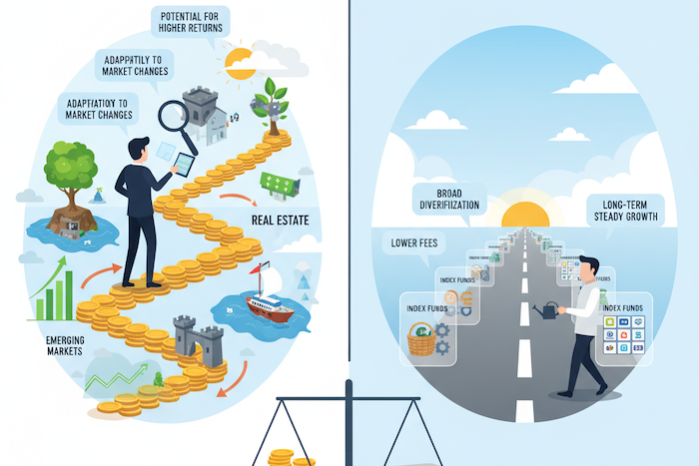
It’s a familiar feeling for anyone who’s ever thought seriously about their financial future. You’re sitting there, maybe after a long day at work, scrolling through news articles, and you’re bombarded with a dizzying array of investment options. One of the most important decisions you'll be faced with is whether to choose between active asset allocation and passive asset allocation. One headline screams about a tech stock that’s soared 300%, while another warns of an impending market crash. Your superannuation statement arrives, and you’re not quite sure what to make of the numbers. The temptation to do something is immense. But what?
Why Active Asset Allocation Matters
This is the crossroads where every investor finds themselves. Do you take the well-trodden path of passive investing, simply buying into the market as a whole through low-cost index funds and letting it ride? Or do you take the more adventurous route of active asset allocation, trying to cleverly navigate the market’s twists and turns to come out ahead? It’s a debate that has raged in financial circles for decades.
While the allure of beating the market is strong, the reality is that active asset allocation is a discipline fraught with peril for the unwary. It’s not just about picking winning stocks; it’s a complex process of managing risk, understanding global economic shifts, and, most importantly, managing your own emotional responses to fear and greed. This article explores why getting active asset allocation right is so critical, the measurable value a professional adviser can bring to the process, and how to navigate the journey of finding the right guide for your financial future in Australia.
The Great Debate: A Simple Path vs. a Winding Road
To understand the challenge, we first need to be clear on the terms. Think of investing in an index fund as getting on a train that travels along with the entire economy. You buy a ticket—a share in the fund—and your investment’s value moves in lockstep with a specific market index, like the ASX 200. It’s a simple, transparent, and wonderfully low-cost way to invest. You’re not trying to be clever; you’re just accepting the market’s average return, which, over the long term, has historically been quite good.
Active asset allocation, on the other hand, is like being the driver of your own all-terrain vehicle. You’re not content to just follow the main road. You believe that by making strategic and tactical shifts—overweighting certain asset classes like international shares when you think they’ll outperform, or moving into the safety of bonds when you sense trouble—you can achieve a better result than the market average. It’s a hands-on approach that requires constant vigilance, research, and a steady hand at the wheel.
The problem? The evidence suggests that most people who try to drive this vehicle themselves end up in a ditch. Research from global investment analysis firm Morningstar provides a sobering reality check. In their 2025 Active/Passive Barometer, they found that over the ten years leading up to the end of 2024, less than 22% of all active fund managers managed to both survive and outperform their average passive counterparts. In the highly efficient U.S. large-cap market, that number was a staggering 7% [1]. The data for Europe tells a similar story, with the ten-year success rate for active managers in the eurozone large-cap equity category standing at a pitiful 5.3% [1].
The data suggests that for many, the penalty for picking a poor active fund normally exceeded the reward for picking a good one [1].
However, the story isn't entirely one-sided. The same Morningstar research reveals that in certain, less-efficient corners of the market, skilled active managers can and do add significant value. In 2024, active managers in fixed income had a stellar year, with 79% of active intermediate core bond managers in the U.S. beating their passive peers. Active real estate funds also showed strong performance, with a 66% success rate for the year [1].
This creates a crucial distinction. Active asset allocation isn’t inherently flawed, but its success is highly dependent on expertise and the specific market you’re operating in. For the average individual, trying to replicate the success of a specialist bond or real estate fund manager is an uphill battle. The data shows that while it’s possible to win, the odds are not in your favour.
The Invisible Hand That Wrecks Portfolios: Your Own Brain
So, why do so many self-directed investors fail when they attempt active management? The answer often lies not in their financial acumen, but in their psychology. The field of behavioural finance has shown us that human beings are wired with a series of cognitive biases that can be disastrous when it comes to making investment decisions.
Russell Investments, in its annual “Value of an Adviser” report, highlights several of these common investment mistakes. Understanding them is the first step to avoiding them.
| Behavioural Bias | Description | Common Mistake |
|---|---|---|
| Loss Aversion | The pain of losing money is felt far more powerfully than the pleasure of an equivalent gain. | Holding on to losing investments for too long, hoping they’ll “come back,” while selling winning investments too early to lock in a profit. |
| Overconfidence | We tend to overestimate our own knowledge and ability to predict the future. | Trading too frequently, chasing “hot tips,” or concentrating a portfolio in a few stocks without understanding the risk. |
| Herding | A deep-seated instinct to follow the actions of the larger group, driven by a fear of being left behind. | Piling into a popular asset after it has already seen significant gains (buying high) and panic-selling during a market downturn (selling low). |
| Familiarity Bias | A natural preference for what is well-known and comfortable. | Over-investing in domestic stocks (like Australian shares) and failing to properly diversify a portfolio globally. |
These biases are not character flaws; they are part of our human DNA. The classic example is the herd mentality during market volatility. Russell Investments points to the COVID-induced market crash in March 2020. An investor who panicked and sold their S&P 500 holdings on March 23rd, when the market hit its low, would have missed a staggering 17.6% rebound over the next three days alone [3]. It’s these emotionally-driven, knee-jerk reactions that do the most damage to long-term wealth creation.
The Quantifiable Value of a Good Financial Adviser
This is where the role of a professional financial adviser becomes so crucial. They are not just investment pickers; they are behavioural coaches. Their greatest value often lies in being the objective, rational voice that stands between you and your worst instincts.
And this value is measurable. The 2024 Russell Investments report for Australia quantified the value added by a financial adviser at approximately 5.7% for the year [2]. What’s most revealing is the breakdown of where this value comes from:
- Behavioural Coaching: 3.3%
- Tax-Effective Planning: 1.3%
- Appropriate Asset Allocation: 1.1%
More than half of the entire value an adviser delivers comes from helping clients avoid the very behavioural mistakes we just discussed. They are the circuit breaker that stops you from selling at the bottom or piling in at the top. They provide the long-term perspective when short-term panic feels overwhelming. When you consider this 5.7% added value against the cost of advice, the benefits become clear.
Understanding the Cost of Professional Guidance
Of course, professional advice is not free. In Australia, the cost of financial advice has been rising, driven by increasing regulatory burdens and a shrinking pool of qualified advisers. According to data from Adviser Ratings, the median ongoing advice fee in Australia for 2025 was $4,668 per annum, an 18% increase from the previous year [4].
Fees can be structured in several ways:
- Initial Advice Fee: A one-off fee for the creation of a comprehensive financial plan, which can range from $4,000 to over $12,000 depending on complexity [5].
- Ongoing Service Fee: An annual fee for regular reviews, portfolio adjustments, and ongoing access to the adviser. This is the most common model.
- Asset-Based Fee: A percentage of the total assets being managed, typically ranging from 0.5% to 2% per year.
While these figures may seem high, it’s essential to frame them against the value being provided. If an adviser can add 5.7% in value through better returns, tax savings, and—most importantly—preventing costly mistakes, then a fee of $4,668 on a substantial portfolio represents a significant net benefit. It’s a shift in mindset from viewing advice as a cost to seeing it as an investment in your financial wellbeing.
How to Choose a Qualified Adviser in Australia
The financial advice industry in Australia is tightly regulated for a reason: to protect consumers. Finding the right adviser is a critical decision, and there’s a clear process you should follow.
First and foremost, anyone providing personal financial advice in Australia must be licensed by the Australian Securities and Investments Commission (ASIC) or be an authorised representative of a licensee. You can and should verify this on ASIC’s Financial Advisers Register [6]. This register also shows an adviser’s qualifications, employment history, and any disciplinary actions against them.
When you first engage with a potential adviser, they must provide you with a Financial Services Guide (FSG). This is a critical document that outlines:
- Their license details.
- The types of services they are authorised to provide.
- How they are paid, including any commissions or benefits from product providers.
- Any associations or relationships they have with financial product issuers.
- Their process for handling complaints.
Treat your first meeting with an adviser like an interview. Don’t be afraid to ask tough questions about their experience, their investment philosophy, their typical client base, and how they would handle your specific situation. A good adviser will welcome this diligence and be transparent in their answers.
The Final Word: It’s Your Future
The journey of building wealth is a marathon, not a sprint. While the simplicity of index funds offers a reliable and effective strategy for many, the potential rewards of a well-executed active asset allocation strategy cannot be dismissed. However, the evidence is clear: going it alone is a path filled with psychological traps and statistical headwinds.
The decision to engage a financial adviser is a personal one, but it should be based on a rational assessment of value, not just cost. By acting as a behavioural coach, a technical expert, and a long-term accountability partner, a qualified adviser can add tangible, measurable value that far outweighs their fees.
Before you make any significant financial decisions, the most prudent step you can take is to seek licensed, professional advice. It’s an investment not just in your portfolio, but in your peace of mind and the security of your financial future.
References
[1] Morningstar. (2025). Active vs. Passive Funds: Performance, Fund Flows, Fees. https://www.morningstar.com/business/insights/blog/funds/active-vs-passive-investing [2] IFA. (2024). Advisers deliver clients 5.7% value in 2024. https://www.ifa.com.au/advisers-deliver-clients-5-7-value-in-2024/ [3] Russell Investments. (n.d.). B Is For Behavioral Mistakes: How Much Value Comes From Prevention. https://russellinvestments.com/us/blog/b-is-for-behavioral-mistakes-how-much-value-comes-from-prevention [4] Professional Planner. (2025). 18 pc jump in ongoing advice fees significantly outpacing inflation. https://www.professionalplanner.com.au/2025/08/18-pc-jump-in-ongoing-advice-fees-significantly-outpacing-inflation-ardata/ [5] Newcastle Advisors. (2024). Why Is Financial Advice So Expensive in Australia. https://www.newcastleadvisors.com.au/blog/why-is-financial-advice-so-expensive-in-australia-understanding-financial-planning-fees-in-2024 [6] Moneysmart.gov.au. (n.d.). Choosing a financial adviser. https://moneysmart.gov.au/financial-advice/choosing-a-financial-adviser


