
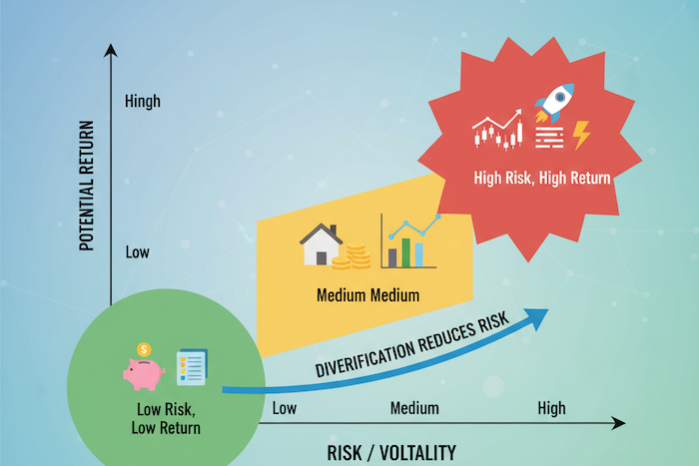
Diversification—the practice of spreading your investments across different asset types—is one of the few tools that reliably reduces risk and volatility without (necessarily) sacrificing return. In the Australian context, where markets can be volatile, interest rates fluctuate, and global events have knock-on effects, adequate diversification helps smooth returns, reduce drawdowns, and preserve capital.
Below, I explain how diversification works, what the evidence shows for different asset classes (cash, bonds, property, shares, metals), types of diversified funds, how financial planners help clients set these up, and practical advice (including pitfalls).
How Diversification Reduces Risk & Volatility
- Correlation & Volatility
- The key mechanism is that different assets tend to respond differently to economic events (they have less-than-perfect correlation). For example, when equity markets drop, bonds or gold might perform relatively better. Including assets with low or negative correlations reduces portfolio volatility.
- A recent Vanguard paper on constructing diversified portfolios in Australia emphasises that well-balanced funds use both growth (e.g. shares) and defensive (e.g. fixed income, cash) assets to manage risk, given investor tolerance, time horizon, cost, etc. (Vanguard Fund Documents)
- Another example: State Street’s “Gold for Australian Investors” shows that gold has had a low or even negative correlation with major equity indices over long periods. That helps reduce “tail risk” (big losses) in bad times. (SSGA)
- Asset Classes & Their Roles
Below are major asset classes, their roles in a diversified portfolio, and what the Australian data/research says.
| Asset Class | Role in Diversification | Empirical / Australian Insights |
| Cash / Cash Equivalents | Lowest risk, high liquidity, buffer for volatility, emergency funds or short-term needs. Returns low, but stability high. | Superannuation funds typically hold some allocation to cash/fixed income to dampen large swings. The paper on Australian superannuation fund allocations (Bissoondoyal-Bheenick et al., 2023) reports that super funds include cash/fixed income as part of growth/defensive splits. (SpringerLink) |
| Bonds / Fixed Income | Serve as a defensive asset; provide income; often move differently than equities; helpful in downturns. | Vanguard Australia’s diversified funds include fixed income to reduce volatility. Also in “Building resilient investment portfolios” they point out international bonds can help mitigate portfolio volatility. (vanguard.com.au) |
| Shares (Domestic & International Equities) | They are the main growth drivers over long term, but carry higher risk. Diversification across geography, sectors helps reduce risk. | Australian superannuation research shows domestic equity and international equity are the biggest contributors to returns for many super funds, but also fields of high volatility. (SpringerLink) |
| Property / Real Assets (Listed & Unlisted) | Often provide income yield, inflation protection, diversification. May have different cycles. | The Martin Currie Australia Diversified Growth strategy, for example, includes “listed real assets (property, utilities, infrastructure)” among its growth-asset mix. (Martin Currie) |
| Metals / Commodities (e.g. Gold) | Precious metals often behave differently than financial assets; gold often used to hedge inflation, deflation, or currency risks; metals sometimes move countercyclically. | As above: gold has low correlation with equities and fixed income in Australia over past 25 years. Gold helps reduce drawdowns & overall volatility. (SSGA) |
Empirical Quantification- Research shows diversified portfolios tend to have substantially lower volatility than concentrated ones. For example, DiscoveryAlert (drawing on Vanguard research) reports people with diversified portfolios experience about 33% lower volatility than those with concentrated holdings. (Discovery Alert)
- The “private assets” study (T. Rowe Price, APAC) shows that adding private assets (e.g. private equity, real estate) to a hypothetical public equity/fixed income portfolio improves the risk-return trade-off (raising returns per unit of risk) when correlations are not too high and volatilities are appropriately adjusted. (T. Rowe Price)
Examples of Diversified Vehicles & Strategies
To illustrate this, the following are common real-world examples of diversification implementation that reduce risk and volatility.
- Multi-Asset Funds
Multi-asset funds (or “balanced”, “growth”, “conservative” funds) invest across asset classes in one pooled fund. For example:- Martin Currie Australia Diversified Growth aims for ~70% growth assets, ~30% defensive. Growth includes Australian & global equities, listed real assets, fixed income, cash. (Martin Currie)
- Vanguard Australia diversified funds (single-fund diversified portfolios) structure different risk/return profiles by varying growth vs defensive asset weightings (e.g. growth options, conservative options). (Vanguard Fund Documents)
- Advantages: you get professional asset allocation, lower maintenance, and built-in rebalancing—disadvantages: fees, possible lag in adapting to new market regimes.
- Index Funds / ETFs
- ETFs (index funds) are efficient tools for exposure: e.g. broad Australian equity index, international equity indices, bond indices, gold etc. They offer low cost, usually high liquidity.
- In “Building a multi-asset portfolio with ETFs” (Australian Shareholders Association / Betashares), there are examples of using a combination of ETFs to build conservative, balanced, growth portfolios, with split across equities, bonds, commodities, cash. (Australian Shareholders Association)
- Index funds remove manager selection risk, often have lower fees than actively managed ones—and over long periods those savings compound. But index funds follow the market, so in very volatile markets you still suffer losses.
- Alternative / Private Assets
- As noted, private real estate, private equity, and “liquid alternatives” can be included to improve diversification, but with caveats: liquidity may be low, risk metrics may be smoothed, correlation estimates may change in stress periods. (T. Rowe Price)
- For example, Russell Investments’ report “Alternative diversifiers” suggests strategies like cross-asset trend or long-volatility can help when both equities and bonds are negatively impacted. (Russell Investments)
What Role Financial Planners Play: Risk Tolerance & Balanced Strategies
Even with good evidence and tools, putting together a diversified portfolio isn’t trivial. This is where a financial planner adds value:
- Determining Risk Tolerance & Time Horizon
A planner will typically assess:- Capacity for loss (how much can the client afford to lose without serious negative consequences);
- Willingness to accept volatility (psychological comfort with swings in portfolio value);
- Time horizon (how long before the money is needed – retirement, children’s education, etc.);
- Liquidity needs (how quickly you may need cash);
- Other sources of income / assets (e.g. property, business, government support).
- These inputs feed into appropriate asset allocations (e.g. more growth vs defensive assets).
- Constructing & Rebalancing Strategy
Once risk profile is known, the planner proposes a strategy: what % in domestic/international shares; fixed income; alternatives; cash; property etc. They also determine whether to use multi-asset funds, ETFs, direct property, or other vehicles.
Rebalancing is essential: because over time, some asset classes outperform, causing drift from target allocations. Regular rebalancing (e.g. yearly or when drift exceeds thresholds) helps maintain intended risk. - Monitoring Costs, Tax, Fees, Behavioral Biases
Planners also help avoid over-reacting to market noise, chasing performance, letting costs erode returns, or being overexposed to home bias (i.e. too much investment in domestic shares). They adjust for tax implications (capital gains, dividends, franking credits for Australian equities) and fees (active vs passive) in total cost.
Practical Advice & Common Pitfalls
Putting this all together, here are concrete suggestions and pitfalls to avoid.
- Advice / Suggestions
- Set clear objectives: know what you want the money for, when you want to use it, what risk you can bear.
- Diversify not just across asset classes but within them: for example, in equities diversify by geography (Australia, US, emerging markets), by sector; in bonds diversify by issuer (sovereign, corporate), by duration.
- Include defensive assets: fixed income, cash, perhaps gold or other commodities. Even though returns are lower, these help in down-markets.
- Use low-cost vehicles where possible: index funds/ETFs or passive options in multi-asset funds reduce drag from fees.
- Don’t ignore private / alternative asset classes, but only if you understand their risks: illiquidity, valuation smoothing, correlation shifts in stress, higher minimums.
- Regular rebalancing: let winners be pared back, add to laggards to maintain target risk. Without rebalancing, portfolios often drift towards riskier allocations (since growth assets often outperform).
- Review periodically: risk tolerance changes over time (e.g. nearing retirement), economic environment changes. But avoid over-tweaking in response to noise.
- Common Pitfalls
- Over-diversification (“diworsification”)
Having so many assets, funds, or products that the marginal benefit of adding another is very small, but you pay fees, incur complexity, tax cost. ASX warns: adding asset classes that do not improve the risk/return trade-off is wasteful. (Australian Securities Exchange) - Correlation assumptions that break down in crises
Correlations among asset classes often increase during extreme stress (e.g. global recession, financial crisis). Something considered “diversifier” in calm times may not protect in a systemic crisis. - Home bias
Australian investors tend to overweight domestic shares and property. This reduces exposure to global growth, and may increase risk if local market suffers. The superannuation allocation research sees domestic equities contribute heavily, but international exposure also important. (SpringerLink) - Higher fees eating return
Active fund management, private assets, frequent trading or rebalancing all cost. If the extra return doesn’t compensate the fees, you lose. Always compare net returns. - Neglecting liquidity and tax
A portfolio filled with illiquid assets or with high frictional costs (tax, transaction costs, bid-ask spreads) may look good on paper, but hard to manage in practice. - Behavioral mistakes
Chasing past winners; panic selling; overconfidence. A diversified strategy helps mitigate these—but planning (and discipline or guidance) is needed.
- Over-diversification (“diworsification”)
Putting It All Together: A Sample Balanced Strategy
To illustrate, here’s how an adviser might put together a reasonably conservative to balanced strategy for a moderate-risk Australian investor with medium-long horizon (say 10+ years), wanting growth but worried about downturns.
| Asset Class | Suggested % | Role | Notes |
| Australian shares | 20-30% | Growth, dividends + franking credits; domestic exposure | |
| International shares | 20-30% | Growth, diversification outside domestic cycles (US, Asia, Emerging) | |
| Listed real assets / property / infrastructure | 5-10% | Income yield, inflation protection | |
| Fixed income / bonds (domestic & international) | 20-30% | Defensive, reduce volatility, generate income | |
| Cash or equivalents | 5% | Liquidity, buffer | |
| Gold / Commodities / Alternatives | 5-10% | Hedge; help when both stocks and bonds underperform |
Within this, planner decides how much in active vs passive, low vs high cost. Planner also sets rebalancing band: e.g. if any asset class drifts ±5% vs target, rebalance back.
Research Evidence Specific to Australia
Some recent or relevant Australian studies / papers support these principles:
- Asset allocation of Australian superannuation funds (Bissoondoyal-Bheenick et al., 2023): used 30 years of data (1990-2019) and shows how super funds shift between conservative / balanced / growth options over time. Domestic equity, international equity, domestic bonds are key contributors to returns; during volatility, larger funds tend to switch more aggressively. (SpringerLink)
- Vanguard’s “Approach to constructing Australian diversified funds”: shows how diversified funds are built, trade-offs considered (risk, return, cost, investor behaviour) in the Australian context. (Vanguard Fund Documents)
- State Street’s gold paper: shows low correlation of gold with equity indices and fixed income in Australia over 25 years, which helps reduce drawdowns. (SSGA)
- T. Rowe Price private assets report (APAC): demonstrates that adding private assets to public portfolios improves efficiency, but also shows that benefit is often overstated if using smoothed reported volatility rather than “real” volatility and considering correlation shifts. (T. Rowe Price)
Why Diversification Is Not Enough: Limitations & What It Doesn’t Solve
While diversification is powerful, it does not eliminate risk. Some risks remain:
- Systemic risk: when an entire economy, market, or financial system suffers (global recession, pandemic, systemic bank failures). Many asset classes can fall together.
- Sequence of returns risk: for retirees or people drawing income, even moderate volatility early can erode long-term outcomes badly.
- Model risk: estimates of correlation, expected return, standard deviation are based on past data. Markets change. What diversified yesterday may not perform so well in a new regime.
- Behavioral risk still exists: investors panicking, ignoring rebalancing, chasing past returns etc.
Steps to Implement a Diversified Strategy
Here’s a checklist to help investors (and planners) ensure the diversification strategy works in practice.
- Define your investment goals and constraints
- What are you investing for?
- What is the time horizon?
- Risk capacity vs risk appetite.
- Construct a target asset allocation
- Decide growth vs defensive split.
- Choose which assets to include: shares (domestic and international), fixed income, property, alternatives, metals etc.
- Choose implementation vehicle(s)
- Direct investment (e.g. shares, real estate).
- Funds/multi-asset funds.
- Index funds / ETFs vs active funds.
- Estimate risk/return & correlation
- Use historical data but adjust for likely changes (interest rate regime, inflation, geopolitical risk etc.)
- Be conservative in estimates.
- Set rebalancing rules
- Either calendar (e.g. annually) or band-based (e.g. if any asset class drifts more than ±5% or so).
- Monitor fees/taxes
- Ensure total cost (management fees, trading costs, tax drag) is reasonable.
- Use tax efficient vehicles where possible (superannuation, franking credits, etc.).
- Stress test
- Simulate bad markets (2008/2009, 2020 etc.). How would portfolio have done?
- Look at “what if bonds fail to protect” scenario (some recent years bonds have correlated more with equities).
- Review periodically
- Revisit risk tolerance as you age or your financial situation changes.
- Consider whether some asset classes have become overvalued or structurally less attractive.
Summary & Conclusion
- Diversification across asset classes (shares, bonds, property, metals etc.), and within those classes, is one of the most reliable tools to reduce volatility and risk in investment portfolios. The empirical evidence in Australia supports this: diversified super funds, multi-asset strategies, and inclusion of defensive assets all help.
- Diversification doesn’t guarantee profits or protect completely from losses, especially in extreme market downturns, but it often improves long-term risk-adjusted returns.
- A financial planner helps by assessing your risk tolerance, setting appropriate allocation, managing costs, rebalancing, and helping you avoid behavioural pitfalls.
- Practical implementation means thinking about cost, liquidity, fees, avoiding over-diversification, being cautious about assuming past relationships always hold, and staying disciplined.
References
- Bissoondoyal-Bheenick, E., Brooks, R., & Do, H. (2023). Asset allocation of Australian superannuation funds: a Markov regime switching approach. Annals of Operations Research. Available at: https://link.springer.com/article/10.1007/s10479-022-04741-0
- Vanguard Australia. Vanguard’s Approach to Constructing Australian Diversified Funds. Available at: https://fund-docs.vanguard.com/vanguards-approach-to-constructing-australian-diversed-funds.pdf
- State Street Global Advisors. (2024). Gold for Australian Investors: Portfolio Diversifier With … Available at: https://www.ssga.com/library-content/assets/pdf/apac/gold/2024/en_gb/gold-for-australian-investors-whitepaper-retail-final.pdf
- Australian Shareholders Association / Betashares. Building a multi-asset portfolio with ETFs. Available at: https://www.australianshareholders.com.au/building-a-multi-asset-portfolio-with-etfs/
- T. Rowe Price (APAC). (2025). A Closer Look at the Diversification Potential of Private Assets. Available at: https://www.troweprice.com/institutional/au/en/insights/articles/2025/q2/a-closer-look-at-the-diversification-potential-of-private-assets-apac.html
- Russell Investments (Australia). (2025). Alternative diversifiers: Rethinking diversification in investment portfolios. Available at: https://russellinvestments.com/-/media/files/au/blog/2025/alternativediversifiers_aus.pdf
- ASX / Morningstar. (2024). Avoiding portfolio ‘diworsification’. Available at: https://www.asx.com.au/blog/investor-update/2024/avoiding-portfolio-diworsification
- Martin Currie Australia. Diversified Growth Strategy. Available at: https://www.martincurrie.com/australia/strategies/australia-diversified-growth
- Vanguard Australia. Building resilient investment portfolios through diversification. Available at: https://www.vanguard.com.au/adviser/learn/insights/portfolio-construction/building-resilient-portfolios-through-diversification
