
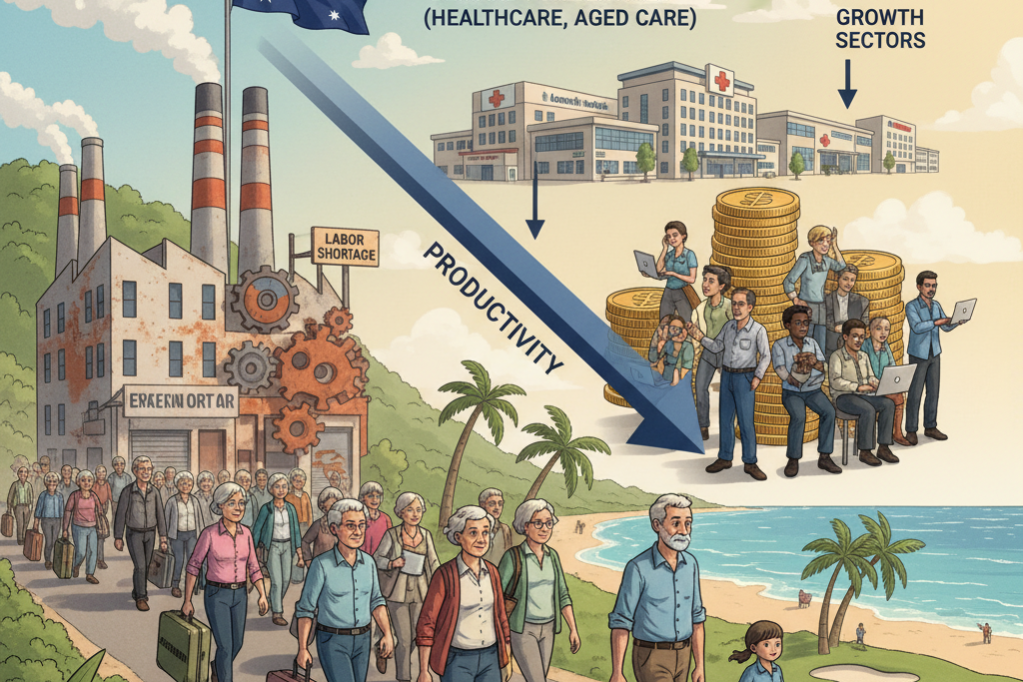
As a financial advisor, my role is to help clients navigate the currents of economic change, and right now, the most powerful current shaping Australia’s long-term financial landscape is the retirement of the Baby Boomer generation. This is not just a demographic footnote; it is a fundamental, structural shift that will redefine our economy, our social services, and the very nature of wealth in this country for decades to come.
The sheer scale of this transition demands our attention. We are witnessing the simultaneous exit of the largest, wealthiest, and most economically dominant generation in Australia’s history from the workforce. The consequences ripple through every sector, from the housing market to the hospital system, and they require a clear-eyed, data-driven response from policymakers, businesses, and individuals alike.
Part I: Defining the Demographic Tsunami
To understand the impact, we must first define the force. Who exactly are the Australian Baby Boomers, and what are their defining characteristics?
Who Are the Baby Boomers?
The term "Baby Boomer" refers to the cohort born in the post-World War II period, generally defined in Australia as those born between 1946 and 1964 (1). This period was marked by a significant and sustained spike in birth rates, a phenomenon driven by post-war prosperity, stability, and optimism.
| Characteristic | Australian Baby Boomer Profile | Source/Data Point |
| Birth Years | 1946 – 1964 | McCrindle Research (1) |
| Current Age Range | Approximately 61 – 79 (as of 2025) | Calculation based on birth years |
| Population Share | Approximately 25% of the population (as of 2021 Census) | ABS (2) |
| Retirement Status | All Boomers will be eligible for retirement within the next five years. | Firstlinks analysis (3) |
| Average Retirement Age | The average age at retirement for those aged 45+ who retired in 2024-25 was 63.8 years (64.9 for men, 62.7 for women). | ABS Retirement Intentions Survey (4) |
The sheer size of this generation meant that as they moved through life—from schools to universities, from first jobs to executive roles—they created a "bulge" that shaped demand and supply in every market they touched. Now, as they move into retirement, they are creating an equally large, but opposite, pressure on the economy.
The Defining Economic Characteristic: Wealth Concentration
The most critical characteristic of the retiring Boomer generation is their unprecedented level of accumulated wealth. They benefited from a unique confluence of factors: the introduction of compulsory superannuation, a long period of economic growth, and, most significantly, a historic boom in the property market.
According to research, the Baby Boomer generation (often defined as 45 to 64 in older data, but now encompassing the 60+ age group) owns more than half of Australia's national wealth (5). Specifically, they hold an estimated 60% of Australia's housing wealth (6). This concentration of assets—particularly in mortgage-free or low-debt residential property—is the engine driving many of the economic impacts we are now observing.
Part II: The Economic and Fiscal Shockwaves
The mass retirement of this cohort is not a gentle slowdown; it is a rapid deceleration of the workforce combined with a surge in demand for specific, costly services.
1. The Strain on Healthcare and Aged Care
The most immediate and profound impact is on the demand for health and aged care services. As a population ages, the incidence of chronic disease and the need for high-level care increases exponentially.
"Australia's aging population presents significant socioeconomic challenges, necessitating the aged care sector reforms." (7).
The Australian Institute of Health and Welfare (AIHW) data clearly shows that the rate of disability and the need for assistance rises sharply with age, with up to 85% of people aged 90 and over requiring some form of assistance (8).
- Increased Expenditure: The Treasury has noted that ageing is likely to cause a deterioration in the government's budget position, largely due to the escalating costs of health and aged care (9).
One model predicted an increase in health expenditure per elderly person from $7,439 in 2015 to $9,594 in 2035 (10).
- Aged Care Demand: The demand for residential and home-based aged care services is set to skyrocket. The government's response, such as the new rights-based Aged Care Act (11), is a direct acknowledgement of the systemic pressure and the need for a massive increase in funding and workforce capacity.
2. The Labour Shortage and Skills Gap
The simultaneous exit of a large, experienced cohort from the workforce creates a "retirement cliff" that is already manifesting as acute labour shortages and a critical skills gap.
- The Scale of the Loss: The sheer volume of retirees is staggering. In 2024-25, 156,000 people aged 45 and over retired (4). This is a continuous drain on the labour pool.
- Skills Erosion: The loss is not just in numbers, but in institutional knowledge and specific skills. A survey of Australian businesses found that 95% expect Baby Boomer retirements to leave a skills gap (12). This is particularly pronounced in sectors that require long training periods, such as trades, engineering, and, critically, healthcare. For example, projections have long warned that Australia could lose almost 60% of its current nursing workforce to retirement (13).
- Economic Drag: A constrained labour supply acts as a brake on economic growth. Businesses cannot expand, projects are delayed, and productivity growth stalls. This forces a policy focus on increasing participation rates for older workers and, more controversially, a rethink of migration policy to fill the gaps (14).
3. Government Revenue and Fiscal Pressure
The fiscal impact is a double-edged sword: rising expenditure combined with a shrinking tax base.
- Reduced Income Tax Revenue: As Boomers move from being high-earning taxpayers to retirees, their contribution to income tax revenue diminishes. While many will still pay tax on superannuation drawdowns, the overall tax take from this cohort will fall.
- Increased Pension and Service Costs: The government faces rising costs for the Age Pension (though many Boomers will be self-funded), healthcare, and aged care subsidies.
- The Budgetary Squeeze: The Commonwealth Treasury has consistently highlighted that population ageing is one of the most significant long-term pressures on the federal budget (9). Managing this structural deficit requires difficult policy choices, such as tax reform, spending restraint, or increasing the retirement age.
4. Superannuation and Capital Market Dynamics
The superannuation system, designed to mitigate the fiscal burden of an ageing population, is now entering its most critical phase: the drawdown.
- The Drawdown Phase: Trillions of dollars accumulated in superannuation funds are now shifting from the accumulation phase to the retirement phase. This changes the dynamics of capital markets. Funds must now manage liquidity to meet regular pension payments, potentially shifting investment strategies away from long-term, illiquid assets towards more conservative, income-generating ones.
- Self-Funded vs. Part-Pension: While many Boomers are self-funded, a significant proportion still rely on the Age Pension, either fully or partially. Data shows that government pension or allowance remains the main source of income for around 44% of women and 49% of men aged 65 and over (15). This highlights the persistent need for a robust social safety net, even with a mature superannuation system.
Part III: Wealth, Housing, and Intergenerational Equity
The retirement of the Baby Boomers is inextricably linked to the issue of intergenerational wealth transfer and the crisis in housing affordability.
1. The Great Wealth Transfer
The most significant financial event of the next two decades will be the $5.4 trillion intergenerational wealth transfer (16). This wealth, largely concentrated in the hands of the Boomers, will pass to their children (Generation X and Millennials).
- Exacerbating Inequality: While the transfer sounds like a solution, it is often a mechanism that exacerbates existing inequality. The primary beneficiaries will be the children of the wealthiest Boomers, who already have a head start. Those from less affluent backgrounds, or those whose parents have exhausted their savings on late-life care, will receive little or no inheritance.
- The Timing Problem: The wealth transfer often occurs too late to solve the most pressing financial challenge for younger generations: housing affordability. A 50-year-old Gen X inheriting a large sum is helpful, but a 30-year-old Millennial struggling to save a deposit needs the capital now.
2. The Housing Market Impact
The Boomer generation's dominance of the housing market is a central pillar of the affordability crisis.
- Housing Wealth Concentration: With Boomers holding the majority of housing wealth, their decisions about when and how to "right-size" or downsize have a massive impact on supply.
- The Downsizing Dilemma: The expected flood of large family homes onto the market has not materialised as quickly as some hoped. Many Boomers are choosing to age in place, often in large, under-occupied homes, due to emotional attachment, stamp duty costs, and a lack of suitable, smaller housing options in their preferred neighbourhoods.
- Policy Intervention: Policy attempts to encourage downsizing, such as the superannuation contribution incentive for 'right-sizing' (17), are aimed at unlocking this supply. However, the impact has been modest. The core issue remains a structural imbalance: a generation with immense housing equity is reluctant to move, while younger generations are locked out.
Part IV: Policy Responses and the Path Forward
The challenges posed by the demographic shift are not insurmountable, but they demand a coordinated, long-term policy response that transcends short-term political cycles.
1. Reforming the Care Economy
The care economy (health, aged care, disability) must be treated as a critical national infrastructure project.
- Workforce Strategy: Australia needs a national strategy to recruit, train, and retain care workers. This includes better pay, improved working conditions, and a clear migration pathway for skilled care professionals. The loss of experienced nurses and aged care workers to retirement must be offset by a massive injection of new talent.
- Technology and Efficiency: Investment in health technology, remote monitoring, and preventative care is essential to manage costs. We must shift the focus from expensive, acute care to maintaining health and independence in the community for as long as possible.
2. Boosting Labour Force Participation
We must find ways to encourage and enable older Australians to remain in the workforce longer, if they choose to do so.
- Incentives for Older Workers: This includes reviewing the Age Pension taper rate and work bonus rules to ensure that working a few days a week does not result in a punitive loss of pension benefits.
- Flexible Work and Skills: Businesses must adapt to offer flexible, part-time, and project-based roles that appeal to retirees. Furthermore, government and industry must invest in reskilling and upskilling programs to ensure the knowledge of retiring Boomers is transferred and that older workers remain technologically relevant.
3. Housing and Wealth Policy
Addressing the intergenerational equity gap requires bold action on housing and wealth.
- Supply-Side Reform: State and local governments must accelerate planning reforms to increase housing density in established, well-serviced areas, which are often the very areas where Boomers are ageing in place. This creates the 'right-sized' housing options needed to facilitate downsizing.
- Tax and Transfer Review: A comprehensive review of the tax system, including stamp duty and land tax, is necessary. Stamp duty, in particular, acts as a significant disincentive for older Australians to move, effectively freezing housing supply.
4. The Long-Term View
Ultimately, the most important policy response is a commitment to long-term fiscal sustainability. The Intergenerational Report (IGR), produced by the Treasury, serves as a vital, if sobering, reminder of the long-term fiscal pressures. Its findings must be the foundation for policy decisions, ensuring that today's choices do not unduly burden future generations.
Conclusion: Planning for a New Financial Reality
The retirement of the Baby Boomers is the single greatest demographic event shaping Australia’s financial future. It is a transition marked by immense challenges—the soaring cost of care, critical labour shortages, and the deepening chasm of intergenerational wealth inequality.
But it is also a transition that presents opportunities. The wealth held by this generation, if managed and transferred effectively, can be a powerful engine for future investment. The necessity of reform in healthcare and the labour market can drive innovation and efficiency.
As a financial advisor, I urge you to look beyond the immediate market fluctuations and focus on these structural shifts. Understanding the demographic imperative is the first step in planning for Australia’s long-term financial stability. For individuals, this means factoring in higher healthcare costs, considering the timing of any expected inheritance, and planning for a potentially longer, more flexible working life. For the nation, it means making the tough, evidence-based policy decisions now to ensure that the legacy of the Boomer generation is one of prosperity, not fiscal strain. The time for action is not in the next decade, but right now, as the wave crests and begins its inevitable break.
References
[1] McCrindle Research. The Generations Defined.
[2] Australian Bureau of Statistics (ABS). 2021 Census shows Millennials overtaking Boomers.
[3] Firstlinks. The Baby Boomer bubble is over, what's next?
[4] Australian Bureau of Statistics (ABS). Retirement and Retirement Intentions, Australia, 2024-25 financial year.
[5] McCrindle Research. Australia's generations by wealth and income.
[6] Inspired Money. Baby Boomers Hold 60% of Australia's Housing Wealth.
[7] Alsaeed, T. (2025). Comprehensive analysis of Australia's aged care system to... PMC.
[8] Australian Institute of Health and Welfare (AIHW). Older Australians, Health – status and functioning.
[9] Treasury. Towards a better understanding of the effects of ageing on economic growth.
[10] Harris, A. (2018). Estimating the future health and aged care expenditure in... PMC.
[11] Department of Health. About the new rights-based Aged Care Act.
[12] Robert Half Survey cited in Staffing Industry Analysts. Australia — Baby boomer retirements raise skills gap worries.
[13] Schofield, D.J. (2007). Replacing the projected retiring baby boomer nursing cohort... PMC.
[14] The Conversation. We must rethink migration to fill the gaps retiring Baby...
[15] Australian Institute of Health and Welfare (AIHW). Older Australians, Income and finances.
[16] ABC News. Another economist warns about intergenerational wealth in Australia.
[17] The New Daily. The win-win-win of Baby Boomer 'right-sizing.


