
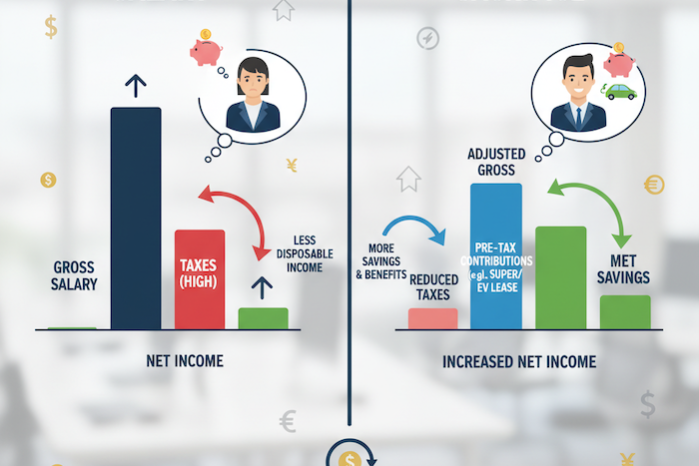
As a financial advisor, one of the most powerful yet often misunderstood tools I discuss with clients is salary sacrifice, also known as salary packaging or total remuneration packaging. It is a strategy that, when implemented correctly, allows you to legally and ethically reduce your taxable income, effectively putting more money back into your pocket or directing it towards your long-term financial goals.
The concept is simple, but the execution requires precision and a deep understanding of Australian tax law. This comprehensive guide will define salary sacrifice, explain its mechanics, explore the most common and beneficial applications—especially the game-changing exemption for electric vehicles—and provide the clear, data-backed insights you need to determine if it is the right strategy for you.
I. Defining and Explaining the Mechanism
What is Salary Sacrifice?
At its core, salary sacrifice is a formal, written agreement between an employee and their employer (1). Under this arrangement, you agree to forgo a portion of your future salary or wages in exchange for your employer providing you with benefits of a similar value.
The critical distinction here is that the arrangement must be made before you earn the income (2).
If you receive your full salary and then decide to use that money to purchase a benefit, that is simply a personal expenditure made with after-tax dollars. Salary sacrifice, by contrast, involves restructuring your total remuneration package so that a portion of your pay is diverted to a benefit before income tax is calculated.
"Salary sacrificing is when an employee forgoes part of their pre-tax salary for non-cash benefits, reducing their assessable income for tax purposes."
The benefit to you is immediate: because the sacrificed amount is not considered part of your assessable income, your overall taxable income is reduced. This, in turn, lowers your personal income tax liability.
The Mechanics of the Arrangement
A salary sacrifice arrangement is not something you can unilaterally decide to do; it requires the full cooperation and agreement of your employer. The process typically follows these steps:
1.Formal Agreement: You and your employer sign a written agreement outlining the specific amount of salary to be sacrificed and the non-cash benefit to be provided. This must be done prospectively—it cannot apply to income you have already earned.
2.Employer Payment: The employer deducts the agreed-upon amount from your gross salary and uses it to pay for the benefit (e.g., a superannuation contribution, a car lease payment, or a laptop).
3.Tax Calculation: Your employer calculates your Pay As You Go (PAYG) withholding tax based on your reduced salary.
4.Benefit Delivery: You receive the benefit, which has been paid for using pre-tax dollars.
The success of the strategy hinges on the difference between your marginal income tax rate and the tax treatment of the benefit itself.
II. Common Types of Salary-Sacrificed Benefits
While the Australian Taxation Office (ATO) allows a wide range of benefits to be packaged, a few stand out for their significant tax advantages.
A. Superannuation Contributions: The Cornerstone of Retirement Planning
Salary sacrificing into superannuation is arguably the most common and straightforward application of the strategy. The mechanics are simple: you direct a portion of your pre-tax salary into your super fund as a concessional contribution.
The tax advantage is clear: your personal marginal tax rate can be as high as 47% (including the Medicare Levy), but concessional contributions are taxed within the super fund at a flat rate of 15% (3).
| Marginal Tax Bracket (2024/25) | Tax Rate on Salary | Tax Rate on Super Contribution | Tax Saving per Dollar Sacrificed |
| $45,001 - $135,000 | 34.5% (32.5% + 2% ML) | 15% | 19.5 cents |
| $135,001 - $190,000 | 39% (37% + 2% ML) | 15% | 24 cents |
| Over $190,000 | 47% (45% + 2% ML) | 15% | 32 cents |
Note: The 15% tax rate on super contributions increases to 30% for individuals whose combined income and concessional contributions exceed $250,000 (Division 293 tax).
This tax differential provides an immediate boost to your retirement savings, allowing compound interest to work on a larger principal over time. However, it is crucial to remain within the annual concessional contributions cap, which is $30,000 for the 2024/25 financial year 4
. Exceeding this cap can result in additional tax liabilities.
B. Novated Car Leases: The Popular Choice, Revolutionised by EVs
A novated lease is a three-way agreement between you, your employer, and a finance company. Your employer takes on the obligation to pay the lease and running costs (fuel, insurance, registration, maintenance) from your pre-tax salary.
Historically, novated leases were subject to Fringe Benefits Tax (FBT), which often complicated the tax benefit. However, the landscape has been dramatically altered by the Electric Vehicle (EV) FBT Exemption.
The EV Game-Changer
To encourage the uptake of zero and low-emission vehicles, the Australian Government introduced an FBT exemption for eligible cars first held and used on or after 1 July 2022 (5). This exemption removes the single largest tax hurdle for novated leases, making them exceptionally attractive for EV adoption.
Eligibility Criteria for the EV FBT Exemption:
1.Vehicle Type: Must be a battery electric vehicle (BEV), a hydrogen fuel cell electric vehicle (FCEV), or a plug-in hybrid electric vehicle (PHEV) (though the exemption for PHEVs is currently scheduled to cease from 1 April 2025) (5).
2.Cost Threshold: The value of the car must be below the Luxury Car Tax (LCT) threshold for fuel-efficient vehicles. For the 2024/25 financial year, this threshold is $91,387 (GST-inclusive) (6).
3.Date of Use: The car must have been first held and used on or after 1 July 2022.
By packaging an eligible EV, you benefit from a triple tax advantage:
1.Income Tax Saving: Lease payments and running costs are paid from your pre-tax salary, reducing your taxable income.
2.GST Saving: The employer (or the lease company on their behalf) can claim the GST on the vehicle purchase price and running costs, and this saving is typically passed on to you.
3.FBT Exemption: The benefit is exempt from FBT, maximising the pre-tax deduction.
C. Other Common Benefits
- Work-Related Items: Items primarily used for work, such as laptops, tablets, mobile phones, and tools of trade, can often be salary packaged. The key is the "otherwise deductible" rule—if you could have claimed a tax deduction for the item had you purchased it yourself, it may be eligible for packaging.
- Housing Benefits for Remote Area Employees: Specific FBT concessions apply to employees living in remote areas, allowing them to salary package housing costs, including rent or mortgage interest, with significant FBT relief (7). This is a targeted benefit designed to incentivise employment in regional and remote Australia.
III. The Tax Advantages and the FBT Equation
The true power of salary sacrifice lies in the tax arbitrage it creates. To fully grasp this, we must look at two critical components: the income tax saving and the application of Fringe Benefits Tax (FBT).
A. Worked Example 1: Maximising Superannuation
Let us consider an Australian employee, Sarah, who earns a gross salary of $120,000 per year. She is in the 37% tax bracket, plus the 2% Medicare Levy, resulting in a marginal tax rate of 39%.
Sarah decides to salary sacrifice $10,000 into her superannuation fund.
| Calculation Component | Without Salary Sacrifice | With Salary Sacrifice |
| Gross Salary | $120,000 | $120,000 |
| Salary Sacrificed | $0 | $10,000 |
| Taxable Income | $120,000 | $110,000 |
| Income Tax on $10,000 (39%) | $3,900 | $0 |
| Super Tax on $10,000 (15%) | N/A | $1,500 |
| Net Tax Saving | N/A | $2,400 ($3,900 - $1,500) |
By sacrificing $10,000, Sarah’s take-home pay is reduced by $7,600 ($10,000 - $2,400), but her super balance is increased by the full $10,000 (less the 15% contributions tax). The net effect is an immediate $2,400 tax saving that is directed towards her retirement, a significant and measurable benefit.
B. Fringe Benefits Tax (FBT) Explained
FBT is a tax paid by employers on certain benefits they provide to their employees (or their employees' associates) in place of salary or wages (8). It is the mechanism designed to prevent the wholesale avoidance of income tax through non-cash benefits.
For most salary-packaged items (like a standard petrol or diesel car), the employer must pay FBT, which is currently levied at the top marginal tax rate (47%). This cost is almost always passed back to the employee, often negating the initial income tax saving.
The Employee Contribution Method (ECM)
To make a benefit tax-effective, employees often use the Employee Contribution Method (ECM). This involves the employee making an after-tax contribution to the employer equal to the FBT liability. Since an after-tax contribution reduces the taxable value of the benefit dollar-for-dollar, a sufficient contribution can reduce the FBT liability to zero.
The true genius of salary sacrifice for non-exempt items is that you are essentially trading a high marginal tax rate (up to 47%) for a lower effective tax rate on the benefit, achieved by paying the FBT liability with after-tax dollars. However, the administrative complexity and the cost of the benefit itself must be carefully weighed.
IV. The Pros and Cons: A Balanced View
While salary sacrifice is a powerful financial tool, it is not a silver bullet. A responsible financial advisor must present a balanced view of the advantages and the potential pitfalls.
The Advantages (Pros)
- Immediate Tax Reduction: The most obvious benefit is the reduction in your assessable income, leading to lower income tax and a higher net wealth position.
- Boosted Superannuation: It is a highly tax-effective way to increase your retirement savings, leveraging the 15% tax rate within the fund.
- Access to GST Savings: For packaged items like cars, the employer can claim the GST, and this saving is typically passed on to the employee, reducing the overall cost of the asset.
- Simplified Budgeting: Having major expenses like car payments or insurance handled automatically from your pre-tax salary can simplify personal budgeting.
- The EV Incentive: The FBT exemption for eligible EVs provides an unprecedented opportunity to acquire a new vehicle at a significantly reduced cost.
The Disadvantages (Cons)
- Impact on Take-Home Pay: The most immediate impact is a reduction in your net cash flow. While you are saving tax, you are also committing a portion of your gross salary to a specific benefit, reducing the money available for day-to-day expenses.
- Administrative Costs: Salary packaging providers charge fees for managing the arrangement. These fees can sometimes erode the tax savings, especially for lower-value benefits.
- Loss of Flexibility: Once the agreement is in place, you are locked into the arrangement for the agreed period.
- The HECS/HELP Trap: This is perhaps the most critical pitfall for many Australians.
The HECS/HELP Repayment Impact
Salary sacrifice reduces your taxable income, but your compulsory HECS/HELP repayment is calculated based on your Repayment Income (RI) (9).
Repayment Income includes your taxable income plus the total net value of any fringe benefits you received, including those from salary sacrifice.
The consequence: While salary sacrifice lowers your taxable income, it increases your Repayment Income. This can push you into a higher repayment bracket, meaning you are required to pay a higher percentage of your income towards your HECS/HELP debt (10).
| Repayment Income (2024/25) | Repayment Rate |
| Below $54,286 | 0% |
| $54,286 - $61,000 | 1.0% - 2.0% |
| ... | ... |
| Over $151,200 | 10.0% |
If you do not account for this increased RI, you may end up with a tax bill at the end of the financial year because your employer has withheld PAYG tax based on your lower taxable income, but the ATO assesses your HECS/HELP liability based on your higher Repayment Income. You must ensure your employer withholds extra tax to cover the increased HECS/HELP liability.
V. Suitability, Common Mistakes, and Maximisation
When is Salary Sacrifice Suitable?
Salary sacrifice is a powerful tool, but it is not universally beneficial. It is most suitable when:
1.You are in a High Marginal Tax Bracket: The higher your marginal tax rate, the greater the tax differential and the more significant the savings. Individuals in the 37% or 45% tax brackets stand to gain the most.
2.You Have a Clear Need for the Benefit: Never sacrifice salary just for the sake of it. If you genuinely need a new car, a laptop for work, or want to boost your retirement savings, the strategy aligns with a tangible financial goal.
3.The Benefit is FBT-Exempt or Concessionally Taxed: Superannuation and eligible EVs offer the clearest, most substantial tax advantages because they are either taxed at a lower rate (15% for super) or are FBT-exempt.
4.Your Employer Offers a Robust Program: A well-managed program with low administrative fees will ensure the tax savings are not eroded by costs.
When is it Not Suitable?
Conversely, salary sacrifice may not be the best option if:
- You are in a Low Tax Bracket: If your marginal tax rate is low, the tax saving may be minimal and could be outweighed by administrative fees.
- You Have Significant Cash Flow Concerns: If reducing your take-home pay, even slightly, would strain your budget, maintaining cash flow should be the priority.
- You are Relying on Government Benefits: Your taxable income is often used to determine eligibility for various government benefits and rebates. Reducing it via salary sacrifice could impact your eligibility, which requires careful modelling.
- You Have a HECS/HELP Debt and are Not Prepared to Manage It: If you are unwilling or unable to arrange for additional PAYG withholding to cover the increased HECS/HELP liability, you risk a tax debt at year-end.
Common Mistakes People Make
Even sophisticated financial strategies are prone to human error. Here are the most common mistakes I see:
1.Failing to Formalise the Agreement Prospectively: The arrangement must be in writing and agreed upon before the work is performed. Retrospective agreements are invalid and will be treated as after-tax payments by the ATO (2).
2.Ignoring the HECS/HELP Repayment Income: This is the single biggest surprise for many employees. They see their taxable income drop and assume they are safe, only to be hit with a large HECS/HELP bill because their Repayment Income has increased.
3.Exceeding Superannuation Contribution Caps: Accidentally breaching the concessional cap (currently $30,000) can result in the excess contributions being taxed at your marginal rate, negating the benefit. Always factor in your employer's mandatory Superannuation Guarantee (SG) contributions.
4.Focusing Only on Tax Savings, Not Total Cost: For novated leases, people often overlook the high interest rates, residual value risk, and management fees charged by the packaging provider. A 10% tax saving on a car is meaningless if the lease interest rate is 15%.
Practical Tips for Maximising the Strategy
To ensure you are working smarter, not just harder, follow these practical steps:
- Prioritise Superannuation: For most Australians, the 15% tax rate on super contributions offers the most reliable and simplest tax saving. Max out your concessional cap (including SG) before considering other benefits.
- Review Annually: Tax laws, contribution caps, and your personal circumstances (salary, HECS/HELP status) change every year. Review your arrangement at the start of each financial year.
- Use the EV Exemption Wisely: If you are in the market for a new car, the FBT-exempt EV novated lease is currently the most powerful salary sacrifice tool available. Ensure the vehicle meets the LCT threshold and eligibility criteria.
- Model the HECS/HELP Impact: If you have a HECS/HELP debt, use the ATO's Repayment Income calculator to estimate your liability and instruct your employer to withhold the necessary additional tax.
- Compare the Total Cost: For novated leases, get quotes from multiple providers and compare the total cost of the lease (including fees and interest) against a standard personal loan. The tax saving must justify the total expense.
VI. Conclusion
Salary sacrifice is a sophisticated financial strategy that, when executed with precision, can significantly enhance your financial position. It is a clear demonstration of how structuring your income can be just as important as earning it.
The current tax landscape, particularly the FBT exemption for electric vehicles, presents unique and compelling opportunities for Australians to optimise their remuneration. However, the complexity of FBT, the critical impact on HECS/HELP repayments, and the strict rules regarding prospective agreements mean that caution is paramount.
Before making any changes to your remuneration structure, you must check your employer's policies to ensure they offer the specific benefits you are interested in. More importantly, you must seek professional financial advice (11).
A qualified advisor can model the precise impact on your personal tax, HECS/HELP debt, and overall cash flow, ensuring you avoid common pitfalls and maximise the strategy for your unique circumstances.
VII. References
[1] Australian Taxation Office (ATO). Salary sacrificing for employees.
[2] Australian Taxation Office (ATO ). When is an arrangement effective?.
[3] Australian Taxation Office (ATO ). Superannuation contributions.
[4] Australian Taxation Office (ATO ). Concessional contributions cap.
[5] Australian Taxation Office (ATO ). Electric cars exemption.
[6] Australian Taxation Office (ATO ). Luxury Car Tax threshold for fuel-efficient vehicles.
[7] Australian Taxation Office (ATO ). FBT concessions for remote area housing.
[8] Australian Taxation Office (ATO ). Fringe benefits tax (FBT).
[9] Australian Taxation Office (ATO ). Repaying your loan.
